
Workshop notes: Tony Yap [Repetition & Exhaustion]
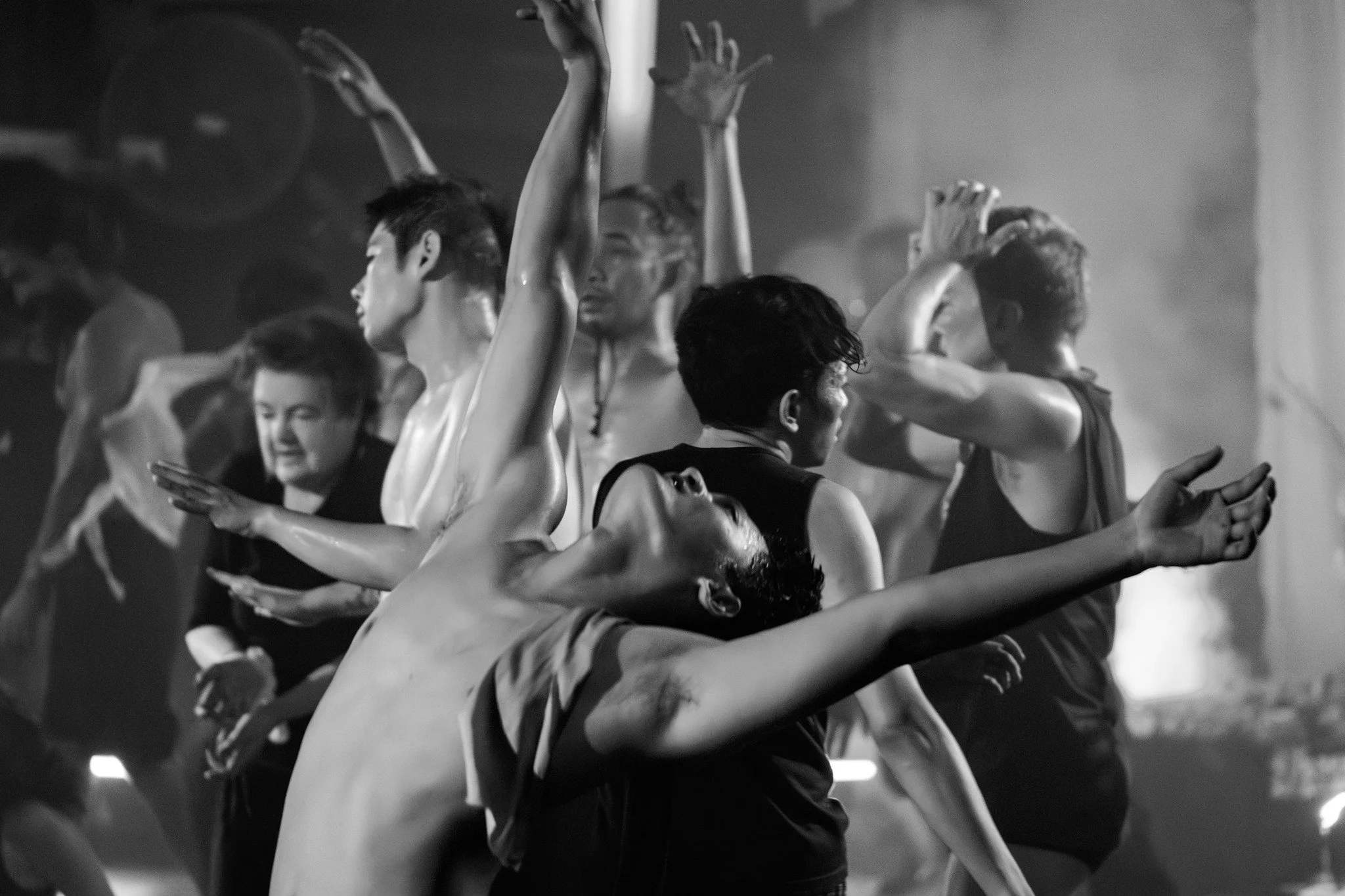
Photo: Tae Swee An
Observations on Repetition, Exhaustion, and the Non-Story Narrative
1. Physiological Adaptation: The "Skills of Oxygen"
Yesterday’s workshop focused on the threshold of repetition and exhaustion, specifically investigating how a precise score can be maintained through "conservation of trance or transformative focus." During the initial two-minute improvisation—set to high-tempo music—my body’s immediate reaction was a standard demand for oxygen. However, I observed a transition where the body ceased to struggle and instead adapted.
Rather than feeling a lack of sophistication due to oxygen shortage, my body developed an internal economy that required less breath than usual. This aligns with the concept I call the skills of oxygen, where the body’s inherent intelligence overrides conscious effort [1]. This shift suggests that exhaustion is not a point of failure, but a point of entry where "the body starts to dance by itself," and the mind becomes a passive observer of the somatic process [2].
2. Physical Force: The "Tremor" and the "Quake"
The core of this practice involves injecting mechanical and intentional physical force into the body to observe how it moves within a movement framework. In this workshop, the focus was on identifying the point where movement moves beyond the category of "dance" and into a state of absolute necessity.
Tony Yap describes this as the "tremor" or "quake". When the intention is speed and spontaneity, the performer moves through a "zone of the indiscernible," where the body is no longer a tool of the ego but an unbridled display of energy. At this threshold, the "quake" functions as a ritualized balancing mechanism, allowing for a transition from domesticated movement into a state of visceral contemplation.
3. The Poetic Narrative: Narrative of Becoming
A significant question arose regarding the "non-story narrative" and how we deliver a story that is not based on a plot. In this movement context, "non-story" is synonymous with the poetic—there is no linear plot, yet the spectator is drawn into an emerging world.
Traditional narrative routines often create a "narrative trap," narrowing the audience's understanding to a fixed, predetermined meaning. Conversely, in a "narrative of becoming," the story is the "immediate, unfolding energy of the body in space" [3]. It is an "efficacious presence of non-thought" that gives the movement a power all its own, allowing meaning to emerge directly from the body's presence rather than from a script [4].
4. Individual Accent and the Refinery of Presence
Even in deep improvised movement, one cannot deny the "individual personality" or the specific "accent" the performer brings to the space. The "refinery process" is how each artist realizes their aesthetic, whether through painting, singing, or movement.
To achieve this deepening by each artist, we look toward a universal system of training that prioritizes energy management over technical skill. This should include the "negation of decreativity" (非芸術性の否定), where we do not block the creative forces by criticizing them or adhering to habitual "bags of tricks" [5]. By following this framework, the performer can facilitate the "tremor" state, allowing the individual accent to emerge while the conscious ego is bypassed by the physical reality of the work.
7 March 2026
Footnotes
[1]: "As the trance is induced or 'descended' into, the depth of the trance and the interiority of imagination prevail from the unconscious." (Yap, T. 2021, Trance-forming Dance, p. 37)
[2]: "After a certain point, as my physical exhaustion grew, my mind became tired and quiet... I felt as if my body started to dance by itself." (Yap, T. 2021, Trance-forming Dance, p. 109)
[3]: "The story is not about 'what happened,' but about the immediate, unfolding energy of the body in space. It is the 'story' of a muscle twitching or a breath catching." (Note: This is an interpretation of the "Phenomenological Presence" discussed on p. 18).
[4]: "There is thought that does not think, thought at work not only in the foreign element of non-thought... this non-thought is not simply a form of absence of thought, it is an efficacious presence of its opposite." (Yap, T. 2021, Trance-forming Dance, p. 129)
[5]: "Emptiness in Chinese Buddhism means 'the negation of decreation'... characteristics: 1. Do not block the creative forces by criticising them..." (Yap, T. 2021, Trance-forming Dance, p. 142-143)
